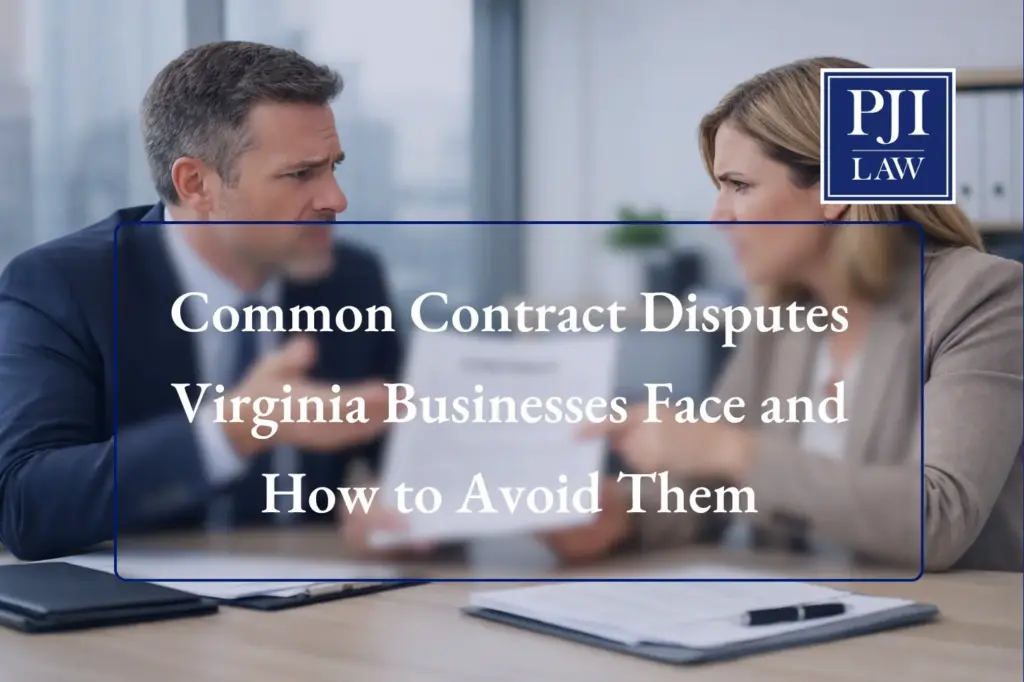
Common Contract Disputes Virginia Businesses Face and How to Avoid Them
In Virginia, contracts are central to how businesses operate. They keep projects on track, safeguard your interests, and establish the responsibilities of everyone involved.
When a party stops meeting obligations or changes how they communicate, the interruption can be felt immediately. Contract disputes affect your time, your money, and the business relationships you rely on. Many Virginia businesses only recognize problems in a contract once performance issues appear or communication stalls. At that point, the dispute may already be forming, and you now have to decide how to move forward without additional strain on your operations.
This blog outlines the contract disputes Virginia companies face, the warning signs to watch for, and the steps you can take to protect your business before conflict escalates.
At a Glance
Key points Virginia business owners should know:
- Early warning signs, including missed deadlines, communication gaps, and invoice disputes, often appear long before a formal breach occurs.
- Common disputes in Virginia involve payment terms, performance issues, NDAs, contract formation, and unclear obligations.
- Risky contract terms, such as ambiguous payment clauses, undefined confidentiality provisions, liquidated damages, and automatic renewals, frequently trigger conflict.
- Preventive steps such as clear drafting, written records, well-defined expectations, and organized documentation reduce the chance of future disputes.
- A Virginia contract dispute lawyer can review agreements, assess whether a breach occurred, and guide you on a strong path forward.

Early Warning Signs a Contract Dispute May Be Developing
Contract disputes in Virginia rarely appear without warning. In many businesses, small problems begin to surface long before one party alleges a breach of contract or initiates litigation. When you recognize these early indicators, you gain more control over the desired outcome, protect your interests, and reduce the chance that a minor issue escalates into a significant business conflict.
1. Changes in Communication or Responsiveness
When the other party stops returning calls or delays responses, the pattern may signal uncertainty about contractual obligations. If project milestones go unconfirmed, the issue can grow into a broader dispute.
2. Requests to Change Terms Mid-Project
Repeated attempts to adjust pricing, extend timelines, or reduce responsibilities may indicate deeper concerns about the provisions in a contract. These requests often appear in many businesses before formal disputes develop, and they can become key evidence later if one party breached the contract.
3. Missed Deadlines and Performance Delays
Early delays often become the root cause of larger contract disputes. Even when a party promises to catch up, missed deadlines affect payment, delivery, and the process the parties expected when signing the contract. This pattern frequently leads Virginia businesses to seek remedies to protect their position.
4. Disagreements Over Invoices or Payment Terms
When payment schedules change, invoices remain unresolved, or the other party disputes charges without explanation, a disagreement may be forming. These conflicts commonly appear in breach of contract matters where the party fails to meet payment terms or challenges financial responsibilities. If not addressed early, these issues often grow into disputes over payment, performance, and the obligations outlined in the agreement.
5. Conflicting Interpretations of Key Contract Terms
A warning sign appears when the other party begins interpreting the contract differently than before. If two parties read the same agreement in conflicting ways, the inconsistency may signal that a future dispute is developing.
6. Irregular or Declining Work Quality
Changes in work quality or performance consistency can signal that a contract dispute is developing. Businesses encounter this issue when a party delivers work that does not match the agreement. If the problem continues, the matter may progress into formal claims that one party breached its obligations under a contract.
Recognizing these early signs helps you determine when to request documentation, clarify responsibilities, or review contracts with a lawyer for a business contract who understands how disputes develop. Taking these proactive steps may prevent future disputes and reduce the likelihood that the disagreement escalates to litigation.
If you’re seeing any of these patterns, this is the right time to review the agreement, not after the dispute escalates.
Common Contract Disputes Virginia Businesses Face

Virginia businesses encounter similar challenges regardless of industry. Below are the dispute categories that most often lead to legal action.
1. Breach of Contract
A breach of contract occurs when one party fails to uphold obligations outlined in an enforceable agreement. The breach may be material or minor, but both can create legal issues if the other party suffered damages.
To prove a breach under Virginia law, you must generally show:
- A valid contract existed between the parties.
- A specific obligation was breached by the defendant.
- You suffered damages or financial loss as a direct outcome of that breach.
- You performed your own duties under the agreement.
Virginia law requires a review of the contract terms first, followed by performance records, communications between the parties, and payment history. When liability is disputed, attention shifts to the provisions that define duties, deadlines, and conditions for performance.
2. Payment-Related Breach of Contract
Payment-related contract disputes are also common in Virginia. These disputes involve missed invoices, partial payments, payment withheld due to quality concerns, or payment delayed beyond agreed deadlines. One party may argue they suffered financial loss because the other side failed to deliver, while the accused party insists the contract allowed them to dispute the invoice.
If you need to pursue damages, the contract’s payment terms, invoicing procedures, and dispute-resolution sections play a central role.
3. Disputes Involving Non-Disclosure Agreements
Non-disclosure agreements (NDAs) present problems when one party believes confidential information was shared without permission. If you signed a legally binding agreement that protects trade secrets, customer lists, pricing strategies, or internal processes, a breach could undermine your competitive position.
To prove a party breached an NDA, you must show:
- A legally binding contract existed.
- Confidential information was disclosed.
- The disclosure violated specific contract terms.
Many NDAs include liquidated damages provisions for quick financial compensation. Virginia law permits liquidated damages clauses when the amount represents a reasonable estimation of harm and is not considered a penalty.
4. Disputes Over Contract Formation
A contract dispute may arise when one party claims the agreement was never legally enforceable. This could happen when:
- The parties involved did not sign the final version.
- One party lacked the authority to bind the company.
- Key contract terms were never agreed upon.
- The contract violates Virginia law.
The review focuses on whether a legally binding agreement existed when the parties intended to finalize it. This review may include emails, signatures, payment records, and conduct that shows both parties acted as though a contract existed.
5. Performance-Related Disputes
A dispute may form when one party delivers substandard work, uses improper materials, or falls behind schedule. These issues appear frequently in construction, vendor contracts, technology services, and consulting arrangements.
When performance disputes escalate, parties may pursue damages or seek an interpretation or clarification of ambiguous or incomplete contract clauses.

Contract Terms That Lead to Major Conflicts
Certain provisions appear repeatedly in Virginia-based contract litigation.
Ambiguous Payment Terms
Without clear payment steps, parties disagree on what triggers payment. Contracts often omit:
- Invoice delivery instructions
- Accepted payment methods
- Deadlines for payment
- Procedures for disputing an invoice
These omissions cause confusion and may lead to financial compensation claims.
Liquidated Damages Provisions
A liquidated damages clause creates a predetermined amount owed if a party breaches a specific term. These provisions are enforceable when the amount is reasonable and reflects anticipated harm, while overly punitive amounts may be rejected.
Dispute Resolution Sections
Some contracts include mediation or arbitration as alternative dispute resolution tools. These methods may reduce litigation costs and give you more control over the resolution process. However, if these sections lack detail, parties may disagree on how and when to start the process.
Non-Disclosure and Confidentiality Clauses
NDAs must define confidential information clearly. Without this definition, parties may dispute whether a disclosure breached the contract. Laws governing confidentiality continue to evolve in Virginia, which makes precise drafting even more important.
Automatic Renewal Provisions
Renewal clauses cause issues when a contract renews without notice. Companies may argue they did not agree to the renewal, while the other party insists the contract language required cancellation in writing.
If your current contracts include these terms, consider having them reviewed to prevent avoidable disagreements later.
How to Avoid Contract Disputes in Virginia

The most effective way to prevent a contract dispute is to focus on the structure of the agreement before work begins. When expectations are documented clearly and supported with strong records, disagreements are less likely to escalate into litigation.
1. Ask for Clear, Detailed Contract Terms
A well-drafted agreement describes:
- The services provided
- Deadlines for performance
- The invoicing and payment process
- The approval process
- How to handle disagreements
- Responsibilities of all parties
Avoid vague phrases such as “reasonable time” or “best efforts,” and request language that spells out deliverables and timelines with precision. When terms are specific, both sides begin the relationship with the same expectations.
2. Review Contracts Thoroughly Before Signing
Review contracts with lawyers for contract disputes experienced in Virginia contract law. An attorney can identify ambiguous terms, flag risk areas, and suggest revisions that protect your interests.
Virginia law requires mutual agreement on all material terms, so the document should reflect what both parties intended when negotiating the agreement.
3. Document All Agreements in Writing
Oral promises create legal issues. Written agreements provide relevant information that may be relied on later if a dispute arises. If changes occur during a project, request that those revisions be documented in a written amendment rather than relying on verbal updates or informal emails.
4. Maintain Organized Records Throughout the Contract Lifecycle
Strong documentation supports your position if a dispute forms. Keep copies of signed agreements, change orders, invoices, payment records, and all communications with the other party.
Detailed records also help demonstrate that you did not waive your rights by continuing performance after a potential breach.
5. Use Non-Disclosure Agreements When Needed
If your business depends on confidential information, NDAs protect your interests. Clearly define what counts as confidential information, the duration of protection, and the obligations of the parties involved.
6. Establish a Process for Communication
Many disputes begin with miscommunication. Regular updates, written notices, and documented approvals create a record that supports your position if the other party later disputes what was agreed upon.
7. Include a Dispute-Resolution Section
Alternative dispute resolution, such as mediation or arbitration, may resolve disagreements without resorting to litigation. These methods can move faster than litigation and may protect ongoing business relationships.
Virginia law also expects parties to take reasonable steps to limit financial loss when a dispute appears to be developing, which makes early communication and documentation even more important.

When to Consider Legal Action in a Contract Dispute
Not all disagreements require court intervention. However, you may consider legal action when:
- The party breached a significant obligation.
- You suffered damages and can document the loss.
- Attempts to resolve the dispute informally were unsuccessful.
- The dispute threatens important business relationships.
- The other party refuses to negotiate.
A contract lawyer can determine what legal options apply to your situation and whether litigation or alternative dispute resolution offers the strongest path toward resolution.
How Most Virginia Contract Disputes Are Resolved
Most contract disputes in Virginia are resolved without going to court. Negotiation, mediation, arbitration, or informal settlement discussions often resolve the issue first.
Businesses often choose these approaches because they are faster, less expensive, and more private than traditional litigation. Many agreements in Virginia also include dispute-resolution requirements, which means the parties must attempt mediation or arbitration before filing a lawsuit.
Even when a lawsuit is filed, it often resolves long before trial. Settlements occur after informal discussions, during discovery, or once the parties understand the strengths and weaknesses of the claims. In some situations, a dispute may close through withdrawal or default if one party stops participating.
Trials generally occur only when the parties cannot agree on the facts, the contract terms, or the value of the claimed financial loss. These situations are the exception rather than the rule.
How PJI Law, PLC Supports Virginia Businesses
PJI Law, PLC works with clients across Fairfax and Northern Virginia who want to protect their business interests and reduce the risk of disputes. Our team reviews contracts, drafts agreements, and represents businesses in breach of contract litigation. Whether you’re preparing to sign a new contract or facing questions about a dispute that already surfaced, our attorneys provide guidance grounded in Virginia law and focused on efficient resolution.
If a disagreement is affecting your business operations, talking with a lawyer early can protect your options and reduce the risk of further loss.

Frequently Asked Questions
Q: What counts as a breach of contract in Virginia?
A: A breach of contract occurs when a party does not fulfill a specific obligation outlined in the agreement. This could involve payment, performance, quality of work, or misuse of confidential information.
Q: Do I need a written contract to bring a claim?
A: No. Virginia recognizes both written and oral contracts. Written agreements offer clearer evidence and carry a five-year statute of limitations under Va. Code § 8.01-246(2). Oral or unwritten agreements carry a three-year limitation period under Va. Code § 8.01-246(4).
Q: What damages can a business recover in a contract dispute?
A: Businesses may recover financial compensation for measurable loss. In limited situations, specific performance (requiring the breaching party to fulfill the contract) or declaratory relief (clarifying rights and obligations) may also be available. Documentation is critical to proving economic harm.
Q: What if the other party claims the contract was never valid?
A: A party may claim the agreement lacked authority, contained unclear or missing terms, or violated Virginia law. Enforceability is determined by examining evidence such as emails, conduct, signatures, payment history, and how the parties behaved to assess whether a valid, binding agreement existed.
Q: Can NDAs and confidentiality clauses be enforced in Virginia?
A: Yes. NDAs can be enforced when they clearly identify the confidential information and protect a legitimate business interest. Provisions may be rejected if they act like penalties or restrict more than what is reasonably necessary.
Q: How can I reduce the risk of future disputes?
A: Clear drafting, documentation, organized communication, and well-defined dispute-resolution terms all strengthen your agreements. Many businesses benefit from attorney review before signing.
Q: When should I contact a lawyer for a contract dispute?
A: If the issue involves missed payments, performance delays, questions about validity, or a disagreement that threatens business operations, it’s time to consult a Virginia contract dispute lawyer.
Protect Your Business With Guidance from PJI Law, PLC
Contracts influence the way your business operates. When a contract dispute interrupts key projects or strains important business relationships, timely legal guidance can make the difference between a brief disruption and a long-term setback. Business owners turn to our firm when they need civil suit lawyers in Virginia who understand how to resolve contract disputes through negotiation, alternative dispute resolution, or litigation when necessary.
At PJI Law, PLC, we work closely with Virginia business owners who need strong, well-structured agreements that reflect their goals and reduce risk across the contract’s lifecycle. If you’d like to review contracts, discuss a dispute, or strengthen future agreements, call us at (703) 865-6100 or contact us online to schedule a complimentary and confidential consultation.
Our team supports clients across Fairfax and Northern Virginia, offering services that protect your interests and respect the time and effort you put into your business.
At PJI Law, you’ll receive white-glove service and personal attention from a team that treats you like family.
Copyright © 2026. PJI Law, PLC. All rights reserved.
The information in this blog post (“post”) is provided for general informational purposes only and may not reflect the current law in your jurisdiction. No information in this post should be construed as legal advice from the individual author or the law firm, nor is it intended to be a substitute for legal counsel on any subject matter. No reader of this post should act or refrain from acting based on any information included in or accessible through this post without seeking the appropriate legal or other professional advice on the particular facts and circumstances at issue from a lawyer licensed in the recipient’s state, country, or other appropriate licensing jurisdiction.
PJI Law, PLC
3900 Jermantown Rd, 2nd Floor
Fairfax, VA 22030
(703) 865-6100
https://pjilaw.com/
Request a Consultation
Call Now: (703) 865-6100(703) 865-6100
* Required Fields
By contacting PJI Law, PLC by any means, you agree that you are not forming an attorney-client relationship. You agree that any information you provide may not remain confidential nor be protected by the attorney-client privilege. Before we can represent you, we have to ensure that there are no conflicts of interest; therefore, do not share any confidential information, and/or information that could harm you if revealed to another party in your matter, until you have entered into a written agreement with us. An attorney-client relationship cannot be formed without a written agreement signed by PJI Law, PLC.